
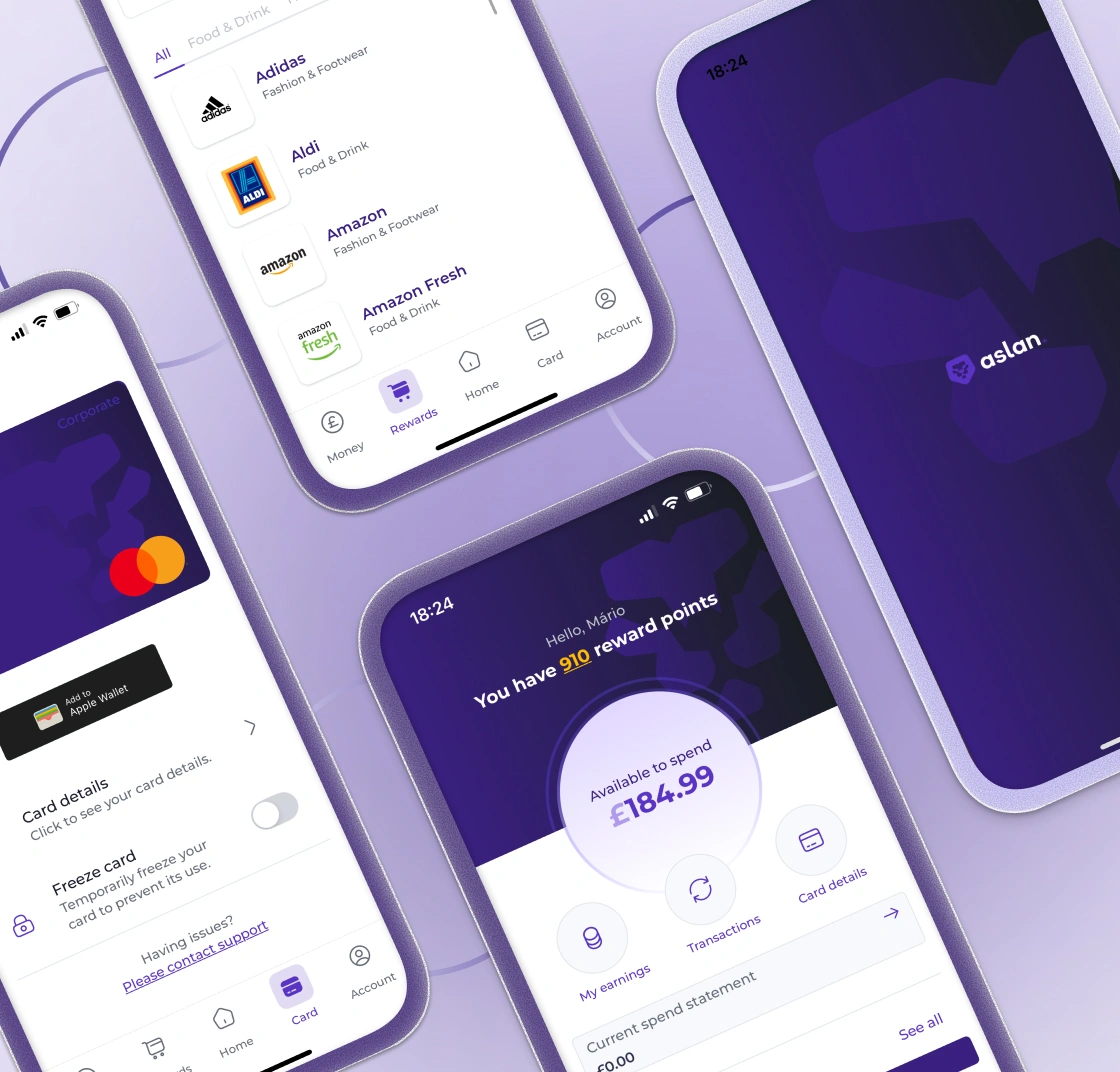
Where fintech apps break
The phone adds risks the web doesn't have. Sensitive data sits on a device you don't control and travels over networks you can't trust. Some of those devices are rooted or carry overlay malware, and the OS can kill your app halfway through a transaction.
All of this has to stay invisible to users who compare your app with the best one on their phone. They'll forgive a slow feed, but not a payment that hangs, a balance that lags behind the bank, a login that locks them out of their own money, a payment taken twice or a flow their screen reader can't finish.
We've built earned wage access, crypto wallets (white-label, stablecoin and Ethereum) and a UK crypto brokerage, and we've embedded senior engineers in a UK lender's mobile team. In every one of them, regulation shaped the design from the start.
What we handle
Compliance and fraud
Security and authentication
User experience
Payments and exact balances
Stack and integrations
Featured work
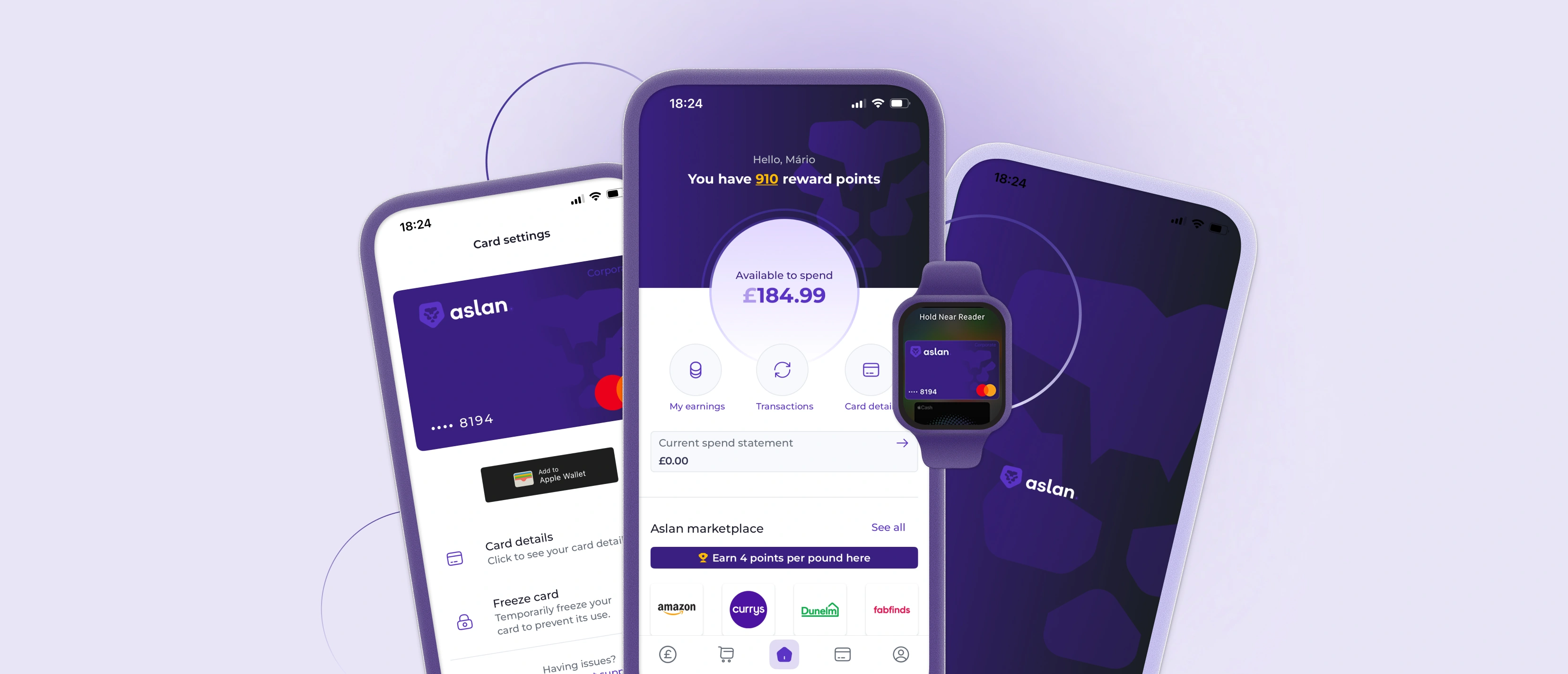
Aslan
We built it end to end: product and project management, architecture, mobile and backend engineering, and design. React Native on mobile, Java and AWS Lambda behind it.
The hard parts were the regulated ones. Cards through Tribe Payments as issuer processor and Monavate as BIN sponsor, Mea Wallet for push provisioning to Apple Pay and Google Pay, PCI-aware data handling, and a forced-update system that keeps every user compliant without breaking their journey.
How we use AI on regulated builds
Plan
Regulation, data flows and failure cases go into the context first, so assumptions surface before any code.
Implement
One scoped task at a time. Small changes a reviewer can actually check.
Validate
Peer review and a dedicated QA pass on every change. On regulated builds, stricter.
Ways to work with us
Zero to One
Product Strategy & Consulting
Team augmentation
Audit & Repair
FAQ
It depends on what the app has to connect to and what it has to comply with. A wallet on top of one payment provider is a different job from a banking app with KYC, cards and open banking. We start with a short discovery that produces a threat model, a map of the integrations and the regulation, and an honest scope before you commit to a build.
Yes, and a lot of our fintech work starts that way. Our senior engineers can embed in your mobile team, as they have in a UK lender's, or we start with an Audit & Repair: a MASVS gap report, a WCAG 2.2 AA audit, a payments review and a prioritised fix plan, and then we fix the gaps before taking on new features.
It depends on the product. Aslan runs on React Native, and that was the right call for a shared codebase and fast delivery. When a product leans on deep platform security, attestation, hardware or wallet features, native Swift and Kotlin can be the better fit, even as native modules or plugins inside a React Native or Flutter app. Kotlin Multiplatform sits in between, sharing business logic with native UI. We recommend by product need, not by the framework we happen to sell.
Yes. We design the app to keep its PCI scope as small as possible: card data is tokenised by your processor, never touches your servers, is never stored on the device, and stays out of logs and analytics. Your certification sits with your organisation and its assessor, but the app arrives with the architecture and the decisions written down, so the audit is a review rather than a rebuild.
We plan for it from discovery. Apple and Google both have specific rules for financial apps, from licensing documentation to how crypto features can work, and we prepare the submission with that in mind. We also build forced and soft update flows, so when a policy or regulation changes, every user moves to a compliant version and old ones can be retired safely.
If you offer consumer banking or payment services in the EU, almost certainly. It has applied since 28 June 2025, and the main exemption is for microenterprises providing services. In the UK, the Equality Act and the FCA's Consumer Duty set the same expectation. That's why we build to WCAG 2.2 AA and test that flows work with a screen reader or larger text from the first release.
We build to OWASP MASVS and test with MASTG against the MAS-L2 and MAS-R profiles, the standard most mobile pen testers check against, and every change goes through peer review and dedicated QA. App attestation helps verify that requests come from a legitimate app instance, and while no regulation requires it by name, it's one of the most effective protections against fake apps and automated attacks on an app that moves money. Personal data is handled under GDPR and UK GDPR by design and is kept out of logs, crash reports, analytics or push notifications, and client code and data only go into AI tools with your approval, never for training.
Every operation that moves money is idempotent, either by design, like a quote the user confirms once, or with an idempotency key on direct payment calls, so a retry after a dropped connection never charges twice. Provider webhooks are deduplicated by their event ID, and balances are reconciled against the processor, so what the user sees matches what actually moved.
Yes. On Aslan we integrated Tribe Payments as issuer processor, Monavate as BIN sponsor and Mea Wallet for push provisioning to Apple Pay and Google Pay. Across other builds we've integrated Enfuce, FIS (Episode Six), Modulr, Stripe, PayPal and M-PESA. We've also connected a crypto custody partner over OAuth2 with HMAC-verified webhooks, Veriff and Sumsub for identity, LexisNexis ThreatMetrix for fraud signals and Salt Edge for open banking. We design every integration for the bad day: timeouts, safe retries and clear states for the user when a provider is down.
Yes, alongside banking and payments. We've built a white-label retail crypto wallet on a custody partner, a UK crypto brokerage with KYC, a stablecoin wallet and Ethereum wallets. The hard parts are the same as any fintech app, plus one more: crypto balances break the decimal assumptions most apps are built on, so the maths has to be exact end to end, and we build with MiCA in mind for the EU and the FCA's cryptoasset promotion rules for the UK.