
In 2023, the US Federal Trade Commission laid out what had been going on inside Ring, the smart-camera company. According to the FTC, one employee spent months watching recordings of customers — in their bedrooms, in their bathrooms. Hundreds of staff and contractors could reach customers' videos whether or not their job needed it. And to teach the cameras to tell a person from a passing car, contractors sat and hand-labelled footage filmed inside people's homes.
None of that needed a villain. It's just what happens by default when you point a camera at someone's life and send the video to a server you don't control. The useful thing — a camera smart enough to know a person from a cat — and the surveillance thing turn out to be the same product.
And it isn't only cameras. The same shape shows up anywhere the data is personal enough to matter. Your financial life — every card tap, every balance, every loan an algorithm quietly scored you for — is exactly the kind of thing you'd rather your bank's app made sense of on your phone than streamed to a data centre. Your health — your resting heart rate, how badly you slept, the symptom you googled at 3am. The messages you assume only two people will ever read. All of it is that Ring footage in a different costume: intensely personal, quietly valuable to someone else, and copied to a server the moment an app gets clever with it.
Building it the other way is more or less what the last four years of on-device AI have been for us.
On-device AI just means the model runs on the phone instead of in the cloud. The photo, the video, the message — the computation happens on the device, and the raw data never leaves it.
That gives you four things: privacy, lower cost, offline, and speed. Every explainer lists those four, in that order or another, and then moves on. I want to stop on the first one, because it's the one I think actually matters most and the one almost no one will ever demand.
Here's the uncomfortable part. We say we care about privacy. We say it in surveys, we say it at dinner. Then a new app asks for our contacts, our camera, our location, and we tap "Accept" without reading a word, because we want the thing on the other side of that button. I do it too. The gap between what we say and what we tap is enormous — and companies build for the tap, not the survey.
So privacy doesn't get built because users won't hold out for it. If it gets built, it's because whoever made the product chose to. On-device AI is the cleanest way I know to make that choice concrete: you can ship the smart camera, the health feature, the scam filter — and simply not be able to see the user's data, because it never arrives on your servers. You didn't promise not to look. You made looking less likely.
The other three benefits are real and I'll happily lean on them when the privacy argument doesn't land:
And I'll be honest about the catch, because pretending there isn't one is how you lose an engineer's trust: models have to be small, phones vary wildly, and pushing an update to a model that lives on a million devices is harder than changing one server. On-device isn't free. It's a tradeoff you take on purpose.
We didn't arrive at any of this in one clean insight. It crept up on us.
2022. The first time on-device AI really came up in our Slack, I did the founder thing and bought a book — Laurence Moroney's AI and Machine Learning for On-Device Development — and it sat on my desk half-read for a while, the way these things do. But the idea stuck.
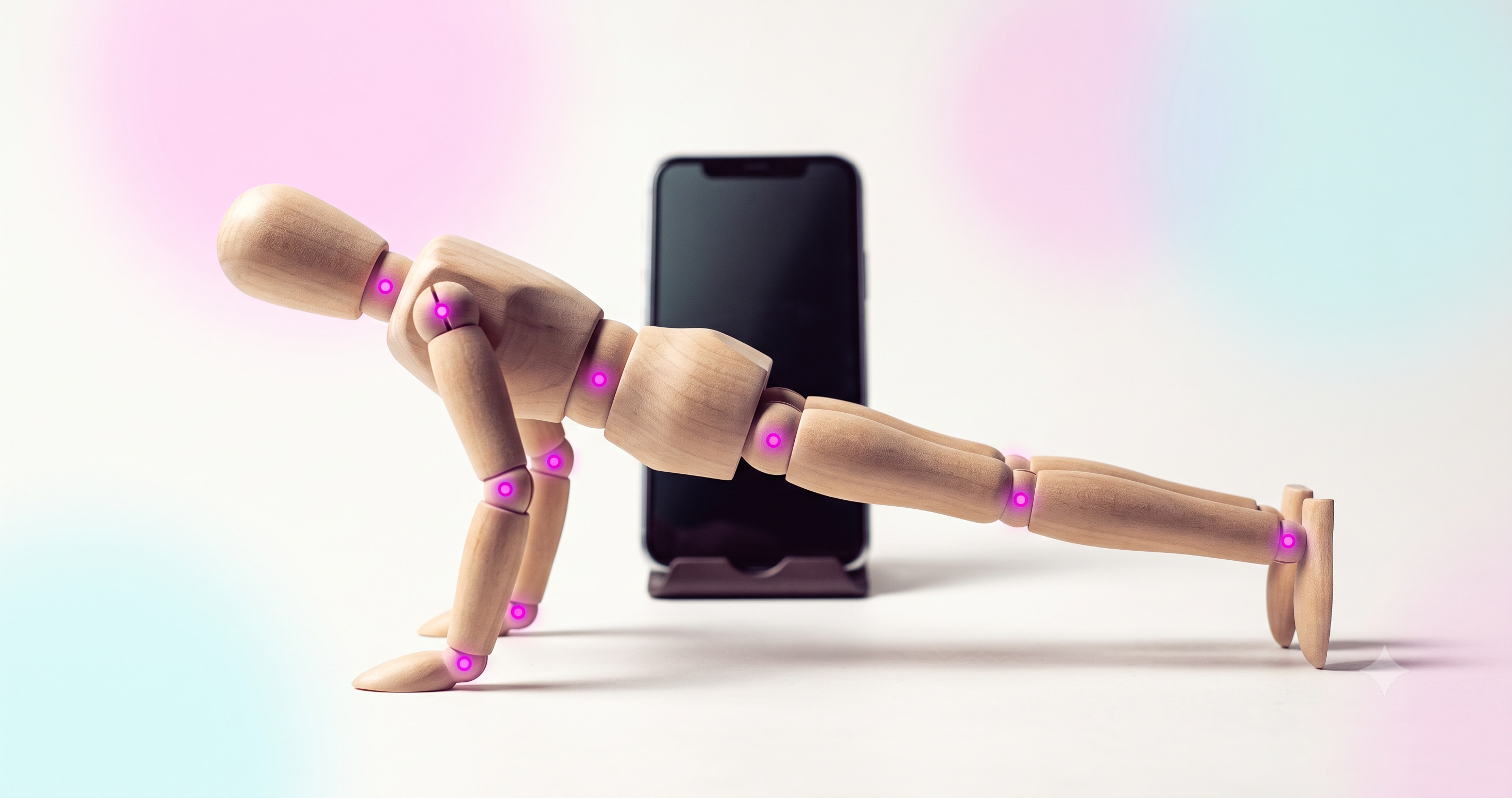
2023. Gonçalo Martins, one of our engineers, turned the curiosity into something real: a blog post where he built a push-up counter that watches you through the camera, using Google's ML Kit pose detection to track 33 body points and count reps — entirely on the phone. His line has aged well: "all the data is processed on the device… no data is sent to external servers." A toy, sure. But a toy that made the point.
2024. It left the lab. The team — with Rafael Baptista leading the build — shipped machine learning inside Barkyn's dog-health app: on the device, in real time, in a real product with real users.
2025. We pushed the hard case. I supervised a master's thesis at FEUP — the University of Porto's engineering faculty — where Gonçalo Almeida built a driver-fatigue detector that runs entirely on a phone: the camera watches your eyes, mouth and head, and warns you when you're nodding off. It flagged fatigue in under a second, ran on a phone from 2016, and — this is the part that matters — the video of your face never left the device.
Sit with that for a second, because it's the exact mirror of the Ring story. It's the same capability — a camera studying a person, continuously, in an intimate space — built the opposite way. On Ring's path, a contractor somewhere ends up watching you. On this path, it’ll be very difficult to happen. Same AI, opposite posture. That's the whole argument in one project. (It's a research prototype, not a shipped product — rule-based, Android-only, and it struggled in sunglasses and glare. I'll take honest over impressive. The thesis is public if you are curious.)
2026. Right now we're building an on-device model that spots scam text messages — the kind trying to phish your bank details — and flags them without a single one of your texts ever leaving your phone. There are a couple of other interesting things in the works, too — we'll share them when they're ready.

Here's where I stop sounding like an idealist. Choosing privacy today isn't just principled — it's early. And being early is a bet: the market could take longer to care than I think. I'll take that bet.
Look at where everything is heading. GDPR, the EU AI Act, Apple's App Tracking Transparency, Google and Apple both pushing more AI onto the device every year. The rules and the platforms are all bending toward keep the data close, justify every byte you take. The behaviour lags — people still tap "Accept" — but the ground is moving under the tap. So when we bet on on-device, we're not betting the market will suddenly grow a conscience; we're betting the direction of travel is obvious, and that the teams who learned to build this way early will be the ones ready when it stops being optional.
I'm Mário, co-founder of Pink Room, a mobile studio in Coimbra — we've shipped 50+ apps across fintech, health and Web3, and on-device AI is the thing we're leaning into hardest right now.
If you're building something that needs to keep its data on the device, we're on LinkedIn and Instagram, or you can send us a message. Thanks for reading.